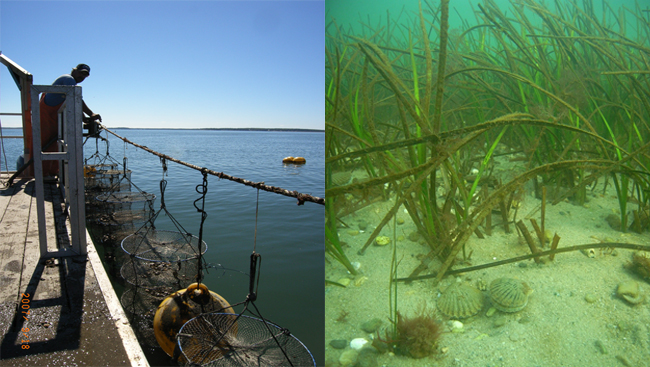
(At left) Cultured scallops in lantern nets, Orient Harbor longlines. (At right) Scallops in eelgrass bed, Orient Harbor. Credit: Stephen Tettelbach
— By Sumayyah Uddin, NYSG's Science Writer
Contact:
Antoinette Clemetson, NYSG Marine Fisheries Specialist, E: aoc5@cornell.edu, P: (631) 632-8730
Stony Brook, NY, December 5, 2025 - On Wednesday, July 16th, 2025, the Peconic Estuary Partnership (PEP) and NY Sea Grant (NYSG) partnered to present the Peconic Bay Scallop Symposium. The Symposium served as an update for stakeholders and members of the public alike about the causes of the Peconic bay scallop mass mortality, an ongoing problem that has negatively impacted the Long Island scallop industry that used to annually contribute millions of dollars to the local economy.
The meeting featured several prominent researchers and stakeholders in the field, as well as guests from PEP, NYSG, local legislature, and more. Notable attendees included Marty Gary (Director of Marine Resources at the DEC), Dr. Stephen Tettelbach (Cornell Cooperative Extension), and NY Assemblyman Tommy John Schiavoni.
“There was a broad range of inputs which gave everybody's perspective,” said Ed Warner, Southampton Town Trustee, on the event. “[Bay scallop mortality is] a puzzle and there's a lot of pieces to it. If we can get all the pieces together and assemble it, I think we can solve the problem.”
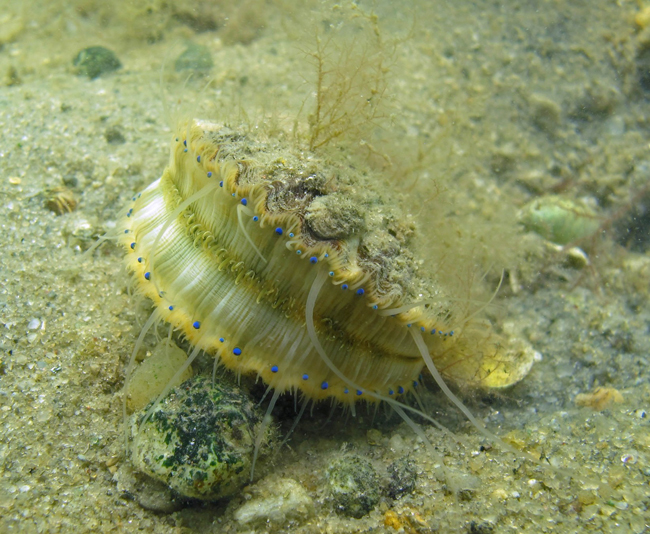
Scallop. Credit: Stephen Tettelbach
History of the Fishery
Occurring along the Atlantic coast down to Florida and extending into the Gulf, the bay scallop is a surprisingly short-lived species with a lifespan of less than two years. This scallop has a long and storied history in New York State; not only is it the official state shell of New York, but at its peak, the commercial fishery on Long Island was considered the most historically and financially important one in Long Island waters.
Commercial harvest of the Peconic bay scallop started in the 1850s. Traditionally done from a sailboat using a small dredge, landings at the turn of the 20th century were significant, with baymen harvesting anywhere from 70,000 to 170,000 bushels — up to (and sometimes over) a million pounds of scallops. Scallops were also an essential part of the culture in these coastal communities, where it was common for children to work after school (sometimes skipping classes) to shuck scallops during the season.
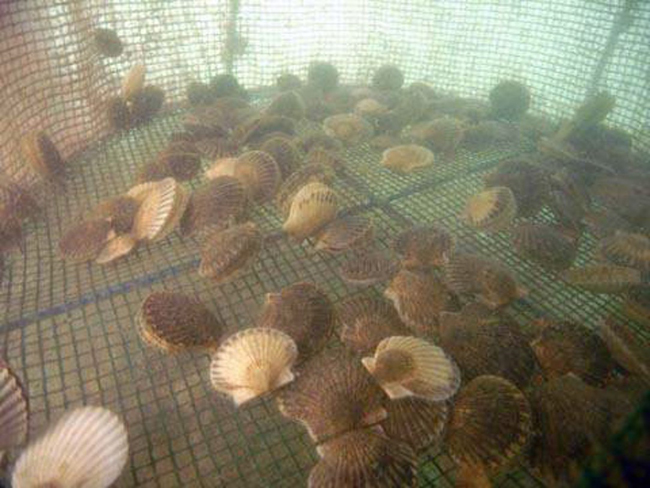
Cultured juvenile scallops in pearl net, Orient Harbor longlines. Credit: Rory MacNish
The industry faced one of its first setbacks in the 1930s, when there was a massive die-off of eelgrass on both the Atlantic coast of North America and in Europe due to Eelgrass Wasting Disease. Then, in 1985, Peconic Bay experienced the first in a series of brown tide outbreaks. Habitat loss creates a huge vulnerability for juveniles that depend on eelgrass beds to settle and grow to maturity.
Prof. Tettelbach (retired), a researcher involved with the scallop restoration effort during this time period, described these harmful algal blooms as “resembling coffee-colored water,” stating that “it was like diving in a closet at night with the lights off and your eyes closed.” These algal blooms had an extremely negative impact on scallops — by shading out eelgrass and causing it to decline even further. Persistent brown tide occurrences meant that scallops both starved to death and experienced reduced recruitment (i.e., adults spawned, but larvae and juveniles were dying).
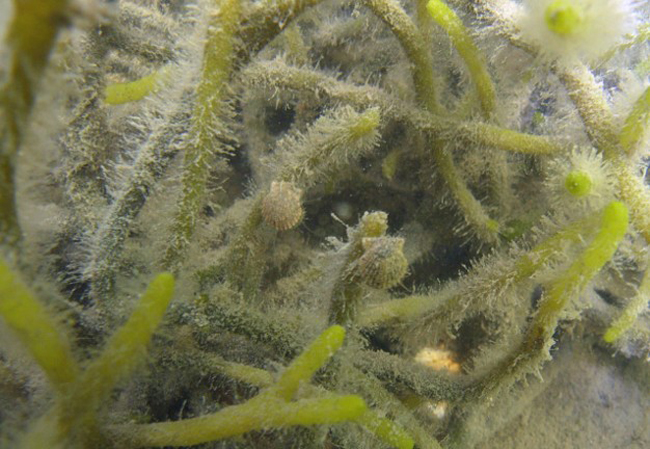
~8 mm juvenile scallops on Codium fragile. August 6, 2007, Hallock Bay. Credit: Stephen Tettelbach
Restoration Efforts
For three consecutive years (1985–1987), the bay scallop population continued to decline, and stakeholders began to worry that this fishery would go extinct. Restoration efforts began from this point, with dedicated baymen and researchers joining forces to collect and disperse healthy scallops, using stock from Cape Cod, MA.
The health and population sizes of the Peconic bay scallop have fluctuated over the years. Several advancements were made in supporting the species, including by using two primary strategies: placing adult scallops in nets, in close proximity to each other to encourage successful fertilization after spawning, and broadcasting seed to the bottom of the bay (free planting). Researchers planted scallops at high densities (~75 to 100 seed per square meter) to increase spawning success. In order to do this, the restoration team adapted a method that was working successfully in Japan: using lantern nets to hold scallops close together. This practice facilitates cross-fertilization due to proximity. An added benefit is that scallops are sheltered from predators like crabs.
These restoration efforts, begun by Cornell Cooperative Extension, Long Island University and Stony Brook University in 2005, were very successful. By 2018, the Peconic Bay fishery sustained levels of commercial harvest that were more than 32 times pre-restoration levels, and markedly increased the economic yield of the fishery.
The 2019 Die-Off: What Happened?
In 2019, bay scallop populations experienced a historic mass die-off as a result of a confluence of events.
A precursory factor to the die-off was the observed decline in spawning (also known as "false spawning”) during the spring. While juvenile recruitment has been strong since 2019, there was high mortality after the first spawning, and scallops were not surviving long enough to make the 2-year mark for commercial harvesting. Scallops spawned in spring help to buffer the population, and these animals have a higher chance to survive winter and conduct a second spawning before completing the 2-year growth cycle for commercial harvest. Without this “second” spawning, the population suffered a precipitous decline, which severely impacted the industry. With ~90 - 100% mortality from spring to fall, the fishery has consistently crashed every year since 2019, and late season spawning has practically disappeared.
Bay scallops are considered “the canary in the coal mine,” according to Tettelbach; they are an early indicator of environmental problems since they are more sensitive to change than other bivalves, such as oysters or clams. In this case, they were sensitive to a disease pathogen. Analyzing samples collected in 2019, Drs. Bassem Allam and Emmanuelle Pales Espinosa (Stony Brook University) determined that a large percentage of bay scallops, if not all, harbor a parasite named Bay Scallop Marosporida (BSM), which eventually kills the animal.
This parasite naturally occurs in the environment; in fact, Dr. Allam noted that scallop tissue samples from the 1900s, obtained from the American Museum of Natural History, contained trace DNA evidence of BSM. Other scallop stocks have been shown to survive in its presence with limited mortality; however, its presence in the Peconic Bay has been devastating.
Warming water temperatures have also had an impact on scallop survival. Research has indicated that, while scallops infected with BSM do deteriorate over time, higher temperatures exacerbate and accelerate the process. Since water temperatures have exceeded the expected levels in the past, and are likely to continue to rise further, this is an aggravating element in bay scallop mortality.
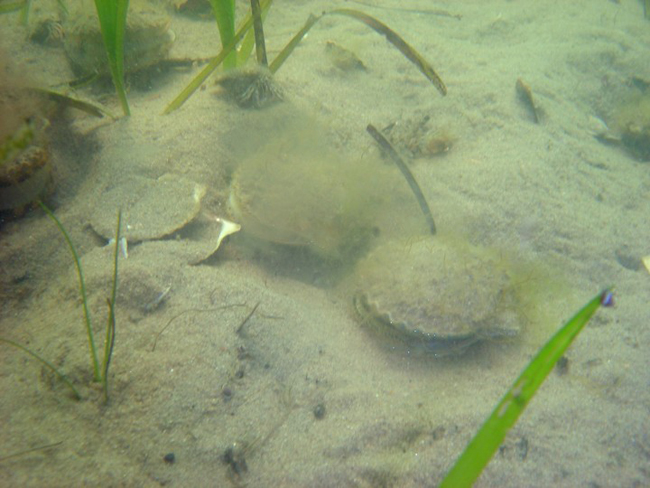
Adult bay scallops spawning in the field. Credit: Stephen Tettelbach (from Tettelbach & Weinstock (2008) Bulletin of Marine Science)
Synthesizing the Research Findings
Allam and his team are working on combating BSM and its damage to the Peconic bay scallop population.
“We [are] trying to understand if we can improve the stock to enhance restoration success and bring back the fishery,” Allam explained.
Allam’s research, conducted over the past five years, has yielded new information about BSM. Initial findings from a sample of infected scallops collected in fall 2019 showed that while most tissues inside scallops were affected by the parasite, it particularly caused damage to the kidneys, altering its entire structure.
“When we say a tissue loss or tissue alteration, it means function loss as well,” Allam pointed out. “Tissues have a job to do, and if the structure is not there, it doesn't do the job.” In this case, the loss of kidney function and the lesions that take over the animal’s tissues lead infected scallops to succumb to kidney failure.
The research team developed several methods to quantify parasitic takeover in scallops, and have identified key aspects of how it affects infected animals.
Timing plays an important role in the survival of scallops infected with BSM. Scallops that spawn in late spring or early summer produce offspring that are exposed to the parasite within their first few months. As a result, they enter their second summer already infected, and those infections worsen rapidly, which leads to high mortality in Year 2. In contrast, scallops that spawn in the fall avoid that first summer's peak infection window. They still become infected the following year, but usually at relatively lower levels, which results in much lower mortality.
Another aspect driving bay scallop mortality is heat. “We had mortality in both treatments,” Dr. Allam noted, “But higher mortality in the heated treatment” — sometimes up to 35 - 45% higher mortality levels. “Animals that are infected do not survive very well at high temperatures. What that means in the field [is] a heavily infected scallop in June or July, with the additional element of environmental stress, is likely not going to make it, especially since kidney function is essential at that time. So we have two different outcomes of how the disease changes based on the starting point: if the scallops are heavily infected, they will die at high temperatures. If they are lightly affected, they will develop disease at high temperatures.”
There was also evidence of genetic selection as an element of survivability. The team identified mutations in some genes that were under strong selection from different seasons, including a mutation in a gene involved in kidney function and disease that was associated with better survivorship.
What’s Next?
Allam’s team has been working on identifying hardier scallop strains. He was quick to emphasize the difference between selective breeding for aquaculture (which leverages genetic traits to build resistance to known stressors) and restorative breeding (which focuses on revitalizing a population in its natural environment and building genetic diversity).
“We are not doing selective breeding, which is typically done in aquaculture to enhance yield. We are focused on restorative breeding, [which means] we are working to bring back the species and the natural system. The goal is to reinvigorate the fishery system — to reinvigorate the population to a degree that it can revitalize the fishery.”
The event left attendees hopeful for the future.
“I want to commend Sea Grant and the Peconic Estuary Partnership for bringing together such an esteemed and important group to study this unique natural resource that we have here,” Schiavoni shared as the symposium came to a close. “It’s one that I have cherished my entire life, and I really look forward to its strong comeback. I'm hopeful that it does.”
See more materials, readings, and resources about Peconic bay scallop research below:
• Survival of the fittest: genomic investigations of the bay scallop reveal a shift in population structure through a summer mortality event
• An apicomplexan parasite drives the collapse of the bay scallop population in New York
• Chromosome-level genome assembly of the bay scallop Argopecten irradians
• Collapse of the New York Bay scallop fishery despite sustained larval and juvenile recruitment
More Info: New York Sea Grant
Established in 1966, the National Oceanic and Atmospheric Administration (NOAA)’s National Sea Grant College Program promotes the informed stewardship of coastal resources in 34 joint federal/state university-based programs in every U.S. coastal state (marine and Great Lakes) and Puerto Rico. The Sea Grant model has also inspired similar projects in the Pacific region, Korea and Indonesia.
Since 1971, New York Sea Grant (NYSG) has represented a statewide network of integrated research, education and extension services promoting coastal community economic vitality, environmental sustainability and citizen awareness and understanding about the State’s marine and Great Lakes resources.
NYSG historically leverages on average a 3 to 6-fold return on each invested federal dollar, annually. We benefit from this, as these resources are invested in Sea Grant staff and their work in communities right here in New York.
Through NYSG’s efforts, the combined talents of university scientists and extension specialists help develop and transfer science-based information to many coastal user groups—businesses and industries, federal, state and local government decision-makers and agency managers, educators, the media and the interested public.
New York Sea Grant, one of the largest of the state Sea Grant programs, is a cooperative program of the State University of New York (SUNY) and Cornell University. The program maintains Great Lakes offices at Cornell University, SUNY Buffalo, Rochester Institute of Technology, SUNY Oswego, the Wayne County Cooperative Extension office in Newark, and in Watertown. In the State's marine waters, NYSG has offices at Stony Brook University and with Cornell Cooperative Extension of Nassau County on Long Island, in Queens, at Brooklyn College, with Cornell Cooperative Extension in NYC, in Bronx, with Cornell Cooperative Extension of Ulster County in Kingston, and with Cornell Cooperative Extension of Westchester County in Elmsford.
For updates on Sea Grant activities: www.nyseagrant.org, follow us on social media (Facebook, Twitter/X, Instagram, Bluesky, LinkedIn, and YouTube). NYSG offers a free e-list sign up via www.nyseagrant.org/nycoastlines for its flagship publication, NY Coastlines/Currents, which it publishes 2-3 times a year.